Who issues "passports" to AI agents? Countries are giving different answers:
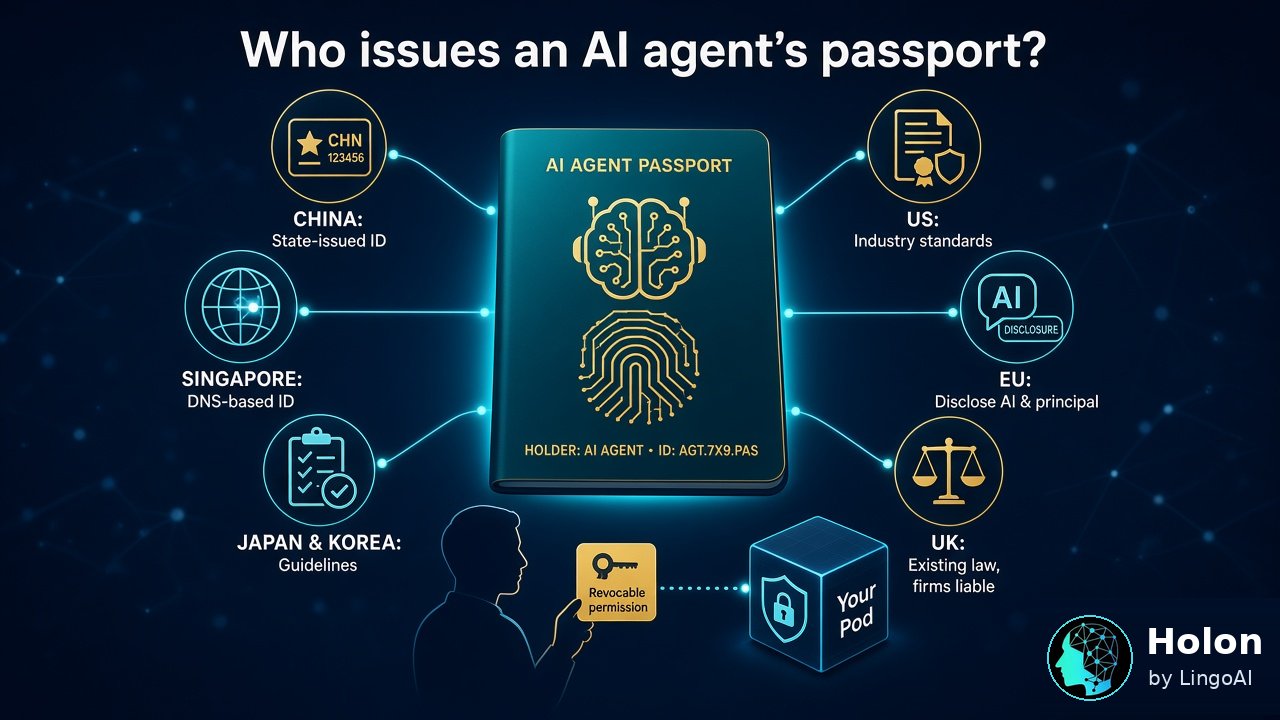
🇨🇳 China: The Ministry of Industry and Information Technology (MIIT) Document No. 42 requires pre-installed agents to be equipped with unique identity codes, and the Cyberspace Administration of China (CAC) has also launched a unified filing system. Identity is issued by the state.
🇸🇬 Singapore: IMDA, along with GoDaddy, Infoblox, Cloudflare, and Google, is exploring using DNS to identify agents while evaluating the need for a national registry. Relying on an open internet architecture.
🇺🇸 United States: NIST is driving industry-led agent identity and authorization standards, and the White House has designated "agent identification and authentication" as a critical national security technology.
🇪🇺 European Union: Since August, AI agents interacting with humans must disclose that they are AI and state whom they represent.
🇬🇧 United Kingdom: No new standalone laws; relying on consumer and data protection laws, holding enterprises accountable for the actions of the agents they deploy.
🇯🇵🇰🇷 Japan & South Korea: South Korea is advancing agent identity verification and accountability, while Japan is revising guidelines to regulate agent permissions and human-in-the-loop intervention.
🌐 International Standards: IETF, W3C, OpenID Foundation, and ISO are all drafting standards for agent identity, discovery, and authorization.
Different paths, but the same question: Whom does this agent represent, what is it authorized to do, and can the authorization be revoked?
Built by LingoAI, Holon is a sovereign personal agent based on Solid Pods, featuring portable memory and revocable authorization:
🏛️ For Nations: Verifiable accountability, compatible with national identity codes, DNS, and W3C credentials, without requiring a centralized database storing nationwide personal data.
🏢 For Organizations: Verifies whom an agent represents and its authorized scope per task, limiting permissions strictly to specified parameters.
👤 For Individuals: Identity belongs to oneself, memory is kept locally, and authorization can be revoked at any time.
LingoAI’s co-founders are also co-founders of the Singapore Internet Governance Forum ( @singaporeigf ). Starting from Singapore🇸🇬, we hope to build an open, interoperable, and human-centric AI agent identity system with global partners to drive the agentic economy.
#AgenticEconomy #AIAgents #DigitalID #Solid #LingoAI
Editorial context: The country-by-country policy and standards overview is reproduced as the author’s account, not independently verified legal guidance in this import. Proposals, standards work and binding obligations have different scopes. Product statements describe an architectural direction: local versus hosted memory depends on deployment, and compatibility or revocation must be verified per integration; no completed nationwide interoperability or universal deployment is asserted here.