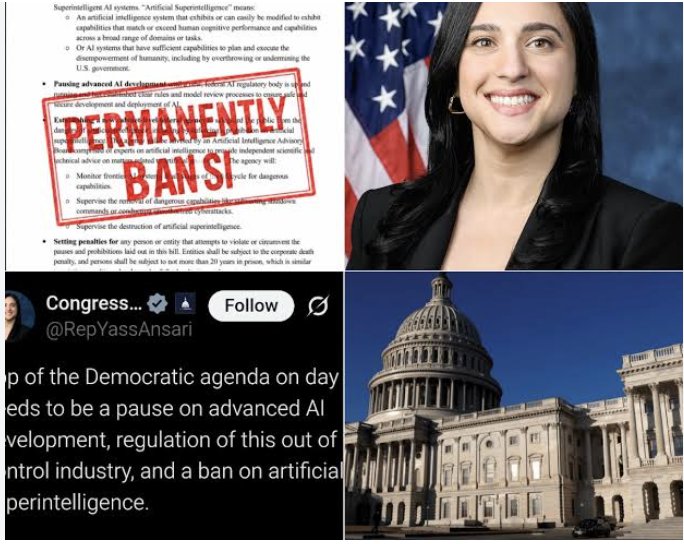
“ Top of the Democratic agenda on day 1 needs to be a
⏸️pause on advanced AI development,
⚖️ regulation of this out of control industry,
🚫 and a ban on artificial superintelligence.”
Pause advanced AI development. Then what?
👽Behind the race for ever greater compute are real costs that “technological progress” cannot excuse: expanding data centers putting pressure on electricity, water, and local environments; AI and robotics turning promises of abundance into 😱anxiety about livelihoods.
When the gains are concentrated and the costs are spread across society—when some imagine superintelligence while others worry about next month’s bills—division should surprise no one.
The debate around Congresswoman Ansari’s call exposes a fracture that will not stop at America’s borders.
🌍 If America pauses, will other countries follow?
Who monitors compliance? How is it verified? If only those who respect the rules apply the brakes, who inherits the advantage?
🛡️ An attacker needs one opening. Defenders must protect countless points of failure.
Is human nature good or evil? We can debate that for centuries. We cannot stake humanity’s safety on everyone choosing to behave well with superintelligence. Destroying a society can be far easier than building one.
⚡ Technology can advance exponentially. Human lives cannot reboot on command.
People who lose their jobs still owe today’s rent and must support today’s families. “New jobs will emerge” does not pay their bills through the transition.
We need pacing: bringing capability growth into step with safety verification, institutional readiness, and society’s ability to adapt.
But the time gained by slowing down must be used to build. Otherwise, we have merely postponed the same unanswered questions.
@patrickc 's challenge goes to the heart of AI optimism: curing diseases and creating material abundance are ingredients. They do not automatically add up to a future people want to inhabit.
https://x.com/patrickc/status/2119495828683530519
What role do humans play? How is wealth distributed? Who holds power? If we take a wrong turn, can we correct it?
And if potentially vast AI populations enter a utilitarian calculation, could human welfare and rights be pushed to the margins?
We cannot keep designing more powerful AI while leaving humanity’s place in that future undefined.
These questions are why @LingoAITech is building AI-native Web3.0 and #Holon Agent 3.0: a foundation for Human-Centric AI that begins with individual sovereignty and connects globally.
🔐 Data ownership
Give people control over their data, identity, and memories through open protocols such as Solid, reducing dependence on any single platform. Your digital self should not depend entirely on one company’s account switch.
🧭 Data and action governance
Connect understanding through a Personal Ontology. Constrain action through explicit authorization. Knowing you better does not give AI the right to decide for you. Greater capability must never automatically mean greater permission.
🤝 Wealth creation and distribution
Develop mechanisms that recognize and reward contributions of data, knowledge, and collaboration. Ordinary people need paths to participate in AI wealth creation and share its benefits while navigating the costs of displacement.
🌐 Global governance and correction
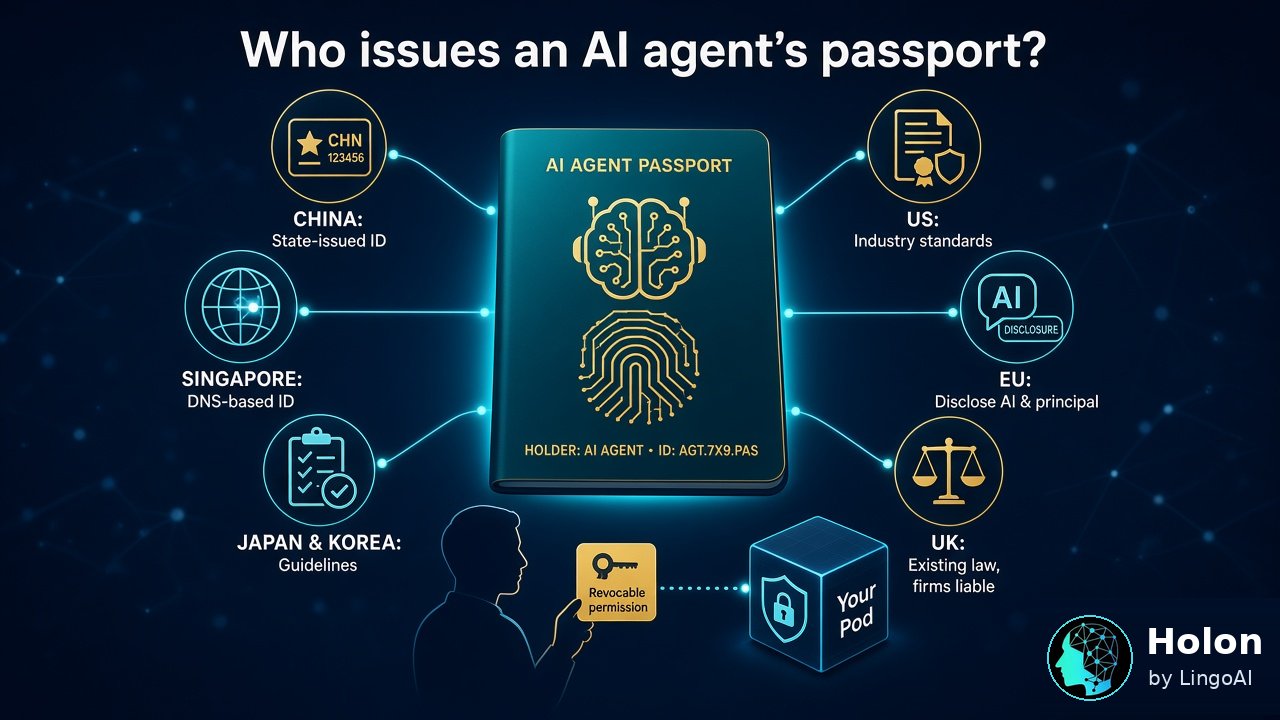
Connect individual sovereignty with cooperation across organizations and borders: revocable authorization, traceable actions, enforceable boundaries, and ways to correct mistakes. Governance must reach every action.
We do not claim that one product can settle every social or philosophical question. But these questions must shape the architecture now. Waiting until power concentrates and societies fracture is waiting too long.
Pacing buys time. What we build determines the direction.
The future we want gives everyone their own AI—and the authority to decide what it may do.
AI can become more powerful. Humans must not become more powerless.
#LingoAI #Holon #HumanCentricAI #Web3 #AIGovernance
Editorial context: The quoted statement is an individual legislator’s policy call, not proof of enacted law or a party-wide adopted platform. The article develops LingoAI’s own response; Patrick Collison’s linked discussion is a separate perspective, not an endorsement. Proposed contribution rewards and governance mechanisms are directions, not an available automatic income system.