🇸🇬 As AI moves from offering advice to acting on our behalf, trust must become part of the infrastructure.
Singapore’s parliamentary adjournment debate on 4 November addressed national digital identity infrastructure for AI agents. MP Tin Pei Ling and Senior Minister of State for Digital Development and Information Jasmin Lau outlined a clear direction for a trusted Agentic Economy.
🔎 Tin proposed a Singpass-like identity infrastructure for agents: identities bound to accountable individuals, teams or organisations; verifiable identities and mandates; and effective blocking when an agent’s authorisation is revoked.
One requirement is particularly important:
“Any material change requires a fresh, documented authorisation.”
She also highlighted the international dimension. Agents cross borders in milliseconds. National infrastructure therefore needs common standards that enable identities and mandates to be verified across systems and jurisdictions.
⚖️ Lau affirmed the objectives behind the proposal and emphasised common standards and interoperability for secure interaction across organisations and platforms. The Government will work with industry on practical approaches before assessing whether additional infrastructure, including a national registry, is needed.
Her words capture the boundary of responsibility:
“Agents can act for us, but they cannot answer for us.”
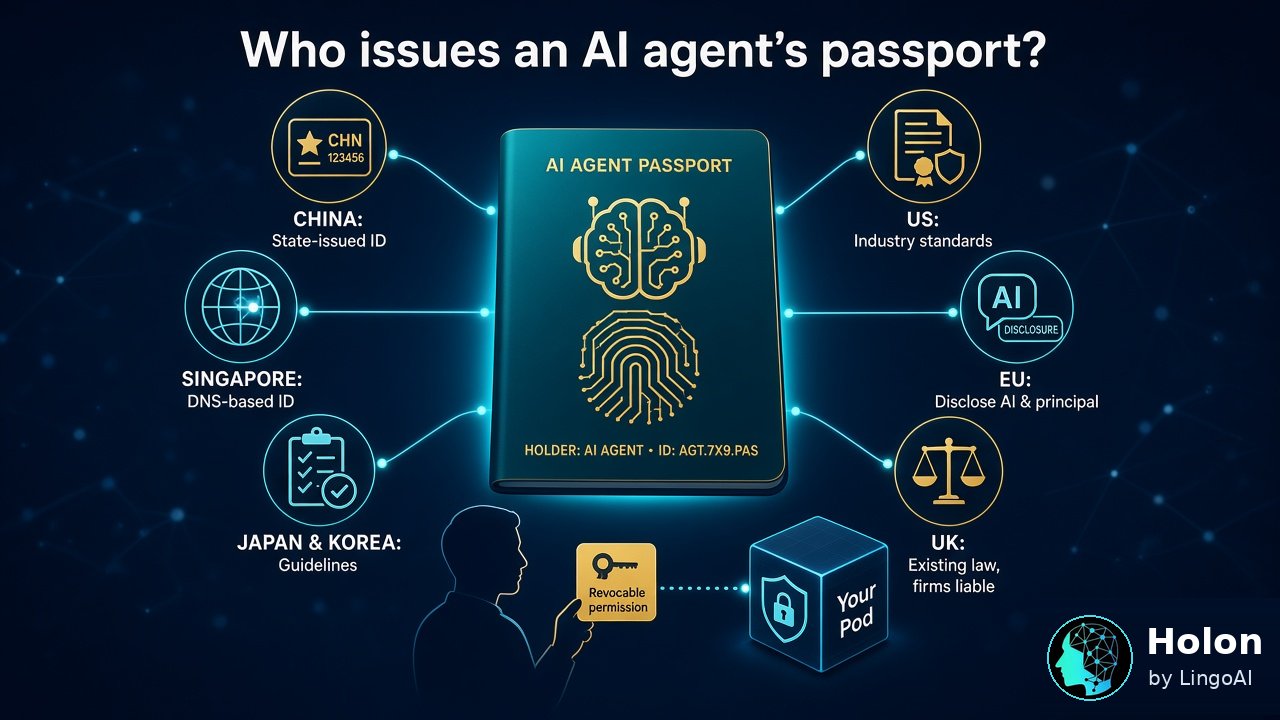
🏛️ Singapore is already moving from discussion towards implementation. IMDA is exploring DNS-based agent identification with technology companies. GovTech is developing an internal agent registry. MAS is working with industry on runtime safeguards to verify identity and authority before financial transactions execute, while preserving auditable records.
🌏 As ASEAN Chair in 2027, Singapore plans to strengthen regional AI governance, testing and assurance, including the adoption of international standards and common testing tools for agentic AI.
Singapore’s leadership lies in connecting policy foresight, technical development, industry collaboration and regional cooperation. Addressing identity, authorisation and accountability before agents become deeply embedded in economic activity is an approach with global relevance.
🛡️ At @LingoAITech , these foundations are central to our work on the Agentic Economy.
We are building #Holon, our vision for Agent 3.0: sovereign personal agents grounded in a Personal Ontology, with users retaining control over their identity, data, memory and permissions.
“One Ontology, Multiple Agents” is our guiding principle. Multiple agents may share an understanding of a person, while each agent’s authority remains explicitly bounded.
Understanding you does not grant permission to act for you. Greater capability must not automatically expand authority. Permissions should be explicit, limited and revocable, with material changes requiring renewed consent.
🤝 Both LingoAI co-founders @HenryWang2021 and @UnaWCX are also co-founders of the Singapore Internet Governance Forum ( @singaporeigf ). Through technical development and multistakeholder dialogue, we aim to connect Singapore’s policy initiatives with global governance discussions, help useful approaches gain international reach, and contribute to Internet and AI governance worldwide.
We welcome collaboration with government, researchers, industry and civil society on open standards, verifiable authorisation and accountable agent actions.
From Singapore, for the world: an Agentic Economy that expands human capability while keeping people in control of their digital sovereignty. 🌐
📺 CNA parliamentary debate:
https://www.channelnewsasia.com/watch/adjournment-motion-national-digital-identity-infrastructure-ai-agents-6524406
#AgenticAI #AgenticEconomy #AIGovernance #Singapore #Holon
Editorial context: The CNA source confirms the subject and date of this parliamentary debate. The post’s wider institutional descriptions and quoted formulations remain attributed to its author; this import is not a legal or implementation audit. A proposal to assess additional infrastructure is distinct from a live national service. Holon’s architectural ambitions are separate from the public publishing functions currently available on this site.